- Cat. No.
- A10543
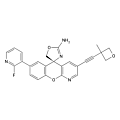
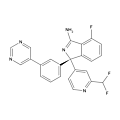
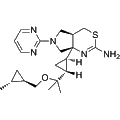
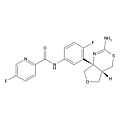
LY2886721
LY2886721 is a novel potent agent that is used to treat Alzheimer's Disease in preclinical experiments.
Search by product name, CAS, target or catalog number. Press Down Arrow to reach product suggestions, Tab to move between links, and Escape to close suggestions.
Beta-secretase (BACE) inhibitors block the aspartic protease that starts the production of amyloid-β peptides. In 1999 beta-site amyloid precursor protein cleaving enzyme 1 (BACE1) was identified as a transmembrane aspartic protease with β-secretase activity. An independent study in the same year purified and cloned the enzyme from human brain. BACE1 cleaves amyloid precursor protein (APP) at the β-site, and γ-secretase then releases amyloid-β, the main peptide of Alzheimer disease plaques. Verubecestat, lanabecestat and LY2886721 are BACE1 inhibitors used to study amyloid-β formation in cells and animal models. LY2811376, AMG-8718 and (Rac)-AZD3839 are further examples for structure-activity and selectivity work. Related compounds for the same pathway are listed under Amyloid-β and γ-Secretase.
LY2886721 is a novel potent agent that is used to treat Alzheimer's Disease in preclinical experiments.
LY2811376 is the first orally available non-peptidic BACE1 inhibitor that produces profound Aβ-lowering effects in animals.
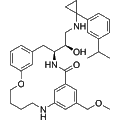
BACE1-IN-1 is a potent and highly brain penetrant BACE1 inhibitor with IC50s of 32 and 47 nM for human BACE1 and BACE2, respectively.
Synonyms: AZD 3293; LY3314814
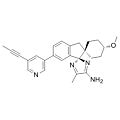
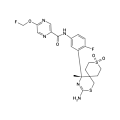
Lanabecestat (AZD3293) is a potent, highly permeable, orally active and blood-brain barrier penetrating BACE1 inhibitor with a Ki of 0.4 nM.
Synonyms: AZD-3839
AZD3839 is a potent and selective inhibitor of human BACE1 with Ki of 26.1 nM.
AMG-8718 is a potent and orally efficacious BACE1 inhibitor.
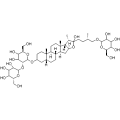
Timosaponin B-II is a major active component of Anemarrhena asphodeloides Bunge (Liliaceae, rhizome) that has protective effects against cerebral ischaemic damage.
Synonyms: MK-8931
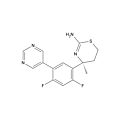
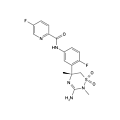
Verubecesta is a potent and selective beta-secretase inhibitor, and BACE1 protein inhibitor or Beta-site APP-cleaving enzyme 1 inhibitor.
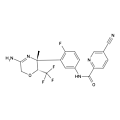
BACE1-IN-4 is a potent and highly selective BACE1 inhibitor, with an IC50 of 3.8 nM and a Ki of 1.9 nM, more selective at BACE1 over BACE2. Anti-Alzheimer's disease.
Synonyms: CNP 520
Umibecestat (CNP520) is a beta-site amyloid precursor protein cleaving enzyme-1 (BACE-1) inhibitor with IC50s of 11 nM and 10 nM for human BACE-1 and mouse BACE-1, respectively.
Synonyms: BIA 2-194
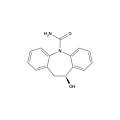
Eslicarbazepine is an oral anticonvulsant indicated for the adjunctive treatment of partial seizures.
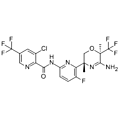
BACE1-IN-2 is a 1,4-Oxazine β-Secretase 1 (BACE1) inhibitor with an IC50 of 22 nM.
Synonyms: E2609
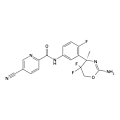
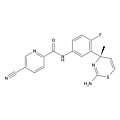
Elenbecestat (E2609) is a potent, orally bioavailable and CNS-penetrant BACE-1 inhibitor for the treatment of Alzheimer's disease (AD).
BACE-1 inhibitor 1 (Compound 8a) is a potent BACE-1 inhibitor with an IC50 of 56 nM.
PF-06751979 is a potent, brain penetrant, β-site amyloid precursor protein cleaving enzyme 1 (BACE1) inhibitor with an IC50 of 7.3 nM in BACE1 binding assay.
LX2343 is a BACE1 enzyme inhibitor with an IC50 value of 11.43±0.36 μM.
β-Secretase Inhibitor IV is a potent, cell-active BACE-1 inhibitor with IC50s of 15.6 and 16.3nM under BACE-1 concentrations of 2 nM and 100 pM, respectively.
Synonyms: AZD 3839
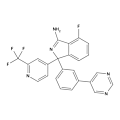
AZD3839 (free base) is a potent and selective BACE1 inhibitor with IC50 of 23.6 uM, about 14-fold selectivity over BACE2, also a β-secretase enzyme inhibitor.
Synonyms: JNJ-54861911
Atabecestat (JNJ-54861911) is a potent brain-penetrant and orally active β-site amyloid precursor protein cleaving enzyme 1 (BACE1) inhibitor, achieves robust and high CSF Aβ reduction.
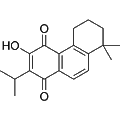
Deoxyneocryptotanshinone is a potent BACE1 (Beta-secretase) inhibitor, exhibiting a high affinity with an IC50 value of 11.53 μM. In addition to its primary targeting of BACE1, it demonstrates dose-dependent inhibition of protein tyrosine phosphatase 1B (PTP1B) with an IC50 of 133.5 μM. This compound is valuable for research applications related to Alzheimer's disease, offering insights into potential therapeutic strategies for neurodegenerative conditions.
NB-216 is a potent BACE-1 inhibitor, exhibiting an IC50 of 17 nM, and is notable for its oral bioavailability and ability to penetrate the blood-brain barrier. In addition, NB-216 demonstrates strong inhibitory activity against cathepsin D and cathepsin E, with IC50 values of 1 nM and 0.4 nM, respectively. This compound is primarily utilized in research focused on Alzheimer's disease, providing valuable insight into the therapeutic modulation of amyloid precursor protein processing.
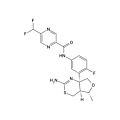
BACE1/2-IN-1 is a potent dual inhibitor of BACE1 and BACE2, exhibiting IC50 values of 0.01 μM and 0.0053 μM, respectively. This compound demonstrates a favorable pharmacokinetic profile characterized by a lower P-glycoprotein efflux ratio and enhanced passive permeability. In addition, BACE1/2-IN-1 is associated with increased metabolic stability in liver microsomes, making it a valuable tool for researching therapeutic strategies targeting amyloid precursor protein processing in Alzheimer's disease.
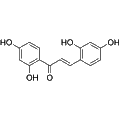
2,2′,4,4′-Tetrahydroxychalcone is a selective and potent inhibitor of Beta-site amyloid precursor protein cleaving enzyme 1 (BACE1) with an IC50 of 0.62 μM. This compound, derived from Isoliquiritigenin found in Glycyrrhiza uralensis, effectively inhibits the β-cleavage of amyloid precursor protein (APP), leading to a reduction in β-amyloid (Aβ) peptide production. 2,2′,4,4′-Tetrahydroxychalcone is used in research related to Alzheimer's disease, providing insights into potential therapeutic avenues for neurodegenerative conditions.
Out of stock
All 3 sizes
AZ3971 is a selective BACE1 inhibitor that effectively penetrates the blood-brain barrier, while leaving γ-secretase activity unaffected. By reducing the production of amyloid-beta (Aβ), AZ3971 serves as a valuable tool in the study of Alzheimer's disease and related neurodegenerative disorders. Its oral bioavailability makes it particularly suitable for in vivo research applications.
β-Secretase-IN-5 is a potent inhibitor of beta-secretase, a key enzyme involved in the cleavage of amyloid precursor protein (APP). By selectively reducing the production of amyloid-beta peptides Aβ1-40 and Aβ1-42, this compound is essential for research into Alzheimer's disease mechanisms and therapeutic strategies. Its application in neurodegenerative studies provides valuable insights into potential treatments for Alzheimer's.